Membership Retention Strategies from Association Experts

The best membership retention strategies for associations focus on personalizing member experiences, streamlining the renewal process, and driving community engagement with data-driven insights.
According to the 2025 Membership Marketing Benchmark Report, associations indicated that member retention and engagement are ongoing challenges. Specifically, associations struggle to address evolving member needs and engage younger members.
These challenges need expert solutions. In this guide, we’ll cover key strategies for membership recruitment and retention:
- Membership Retention FAQ
- Performing a Membership Assessment
- How to Conduct Membership Research
- 4 Membership Retention Strategies
As you evaluate the current state of your membership, research members’ preferences, and implement these strategies, you’ll need effective technology like a Salesforce-powered association management solution by your side. A dedicated AMS can do everything from managing your daily operations to tracking the effectiveness of your strategies.
Let’s start with the basics by defining terms and key performance indicators (KPIs) related to member retention.

Membership Retention FAQ
What is membership renewal or retention?
Membership retention is the process of keeping members engaged and active in your association. In other words, it’s doing all the things you need to do to motivate members to renew their membership each renewal period.
What is membership recruitment?
Membership recruitment is the process of attracting new members to your association. This is one of the first steps in the membership lifecycle, just after the awareness stage (when prospects first learn about your association). Keep in mind that your approach to recruitment and onboarding will set the tone for new members’ experiences with your association.
Track recruitment success with the following KPIs:
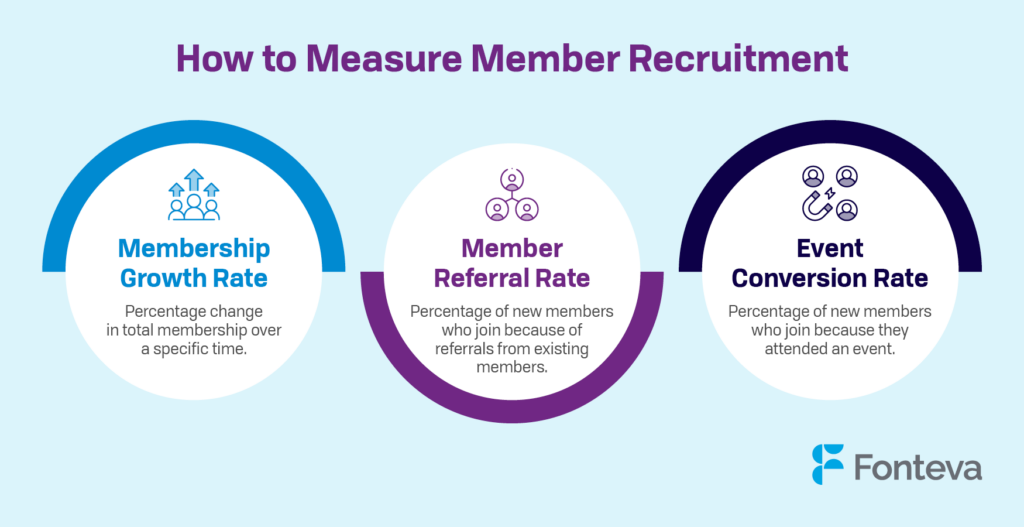
- Membership growth rate: The percentage change in total membership over a specific time (e.g., year over year). For most associations, a growth rate of 10% year over year is healthy.
- Member referral rate: The percentage of new members who join because of referrals from existing members. Generally, a referral rate of 10% to 20% is a strong indicator of success.
- Event conversion rate: The percentage of new members who join because they attended one of your events. If you are organizing events with recruiting as the primary goal, shoot for a conversion rate of 20% to 30%.
How can associations track member retention?
You’ll need to track KPIs for both member engagement and retention in your membership software, as member engagement patterns can help you predict retention trends and identify members at risk of lapse.
Check out this interactive dashboard to learn more about these metrics:
Analytics Overview
Membership Retention Dashboard
Hover or tap any card to reveal industry benchmarks and targets.
How can associations prevent involuntary lapses?
Involuntary or passive lapses occur when a member intends to renew, but their credit card expires, they miss or don’t receive renewal reminders, or they simply forget. Your association can prevent this with the right technology.
Implement an association management solution that supports auto-renewals and credit card updater capabilities. These tools allow members to opt into automatic renewals and prompt them to update expired credit card information to prevent payment issues. Additionally, choose a platform that allows you to configure automated renewal reminder emails so members never forget.
Should retention strategies differ for corporate versus individual members?
Yes. Corporate accounts usually focus more on organizational ROI, such as employee training credits or brand visibility, while individual members often prioritize career-centric benefits, such as networking opportunities.
If your association has both types of members, consider segmenting them into different audiences. Then create targeted communications that appeal to each segment’s unique needs and goals.
Performing a Membership Assessment
These assessments help associations understand members’ needs and interests to proactively identify gaps in their offerings. If your association offers different types or levels of membership, assess each one to determine which ones are performing well and which are underperforming.
Let’s look at an example of an association offering student memberships for those seeking to enter a selected profession. The association examines its chapters on college campuses, asking the following questions:
- On which campuses are the chapters most successful and why?
- Do they have a strong level of member engagement?
- Do these chapters have a higher percentage of members from related majors?
- Do these chapters have visible and active student leadership and faculty sponsorship?
- How much more likely are their student members to become professional members upon graduation or when entering the workforce in their chosen field?
- How do these successful college chapters compare with other less successful collegiate chapters?
- How do these campuses differ from comparable colleges and universities?
- Is there a region of the country where college chapters of your association thrive more? Why?
- What can be done to bolster the efforts of college chapters and provide more support to chapter leadership?
Investing in these assessments can be time-consuming, but you’ll gain the insights needed to engage and support members, particularly during pivotal moments or transitions in their careers. But before taking action, you’ll need to conduct one more round of research.
How to Conduct Membership Research
In addition to investigating your internal membership recruitment and engagement efforts, you’ll need to research members’ needs and opinions of your offerings. The best way to do this is by developing surveys that ask members about:
- Which of your resources, programs, or events they found most helpful in the last quarter or year
- Whether your current offerings are meeting their needs
- What your association can do to support their professional development
- Their top goals and priorities for their career
- Which industry trends and topics they are most interested in
- Any suggestions they have for your association going forward
Associations that ask questions and truly listen to their members will find that they have a more engaged member base that renews their memberships at a higher rate, is more likely to volunteer, and believes that their perspective matters. Additionally, your association will learn what it needs to do to better support members and be a truly indispensable part of their careers.
4 Membership Retention Strategies
1. Conduct listening tours.
A listening tour is a structured series of meetings that gives your association leaders a chance to hear what members and staff have to say about their experiences. For example, an association executive might plan dinners with each association chapter. During the dinners, they’ll have members reflect on their experiences and ask open-ended questions that guide the conversation to gather diverse perspectives.
When we asked association executives about why listening tours are so important and effective, this is what they had to say:
- Stacy Tetschner, President and CEO, American Traffic Safety Services Association (ATSSA): “For someone who’s newer in this industry, I come in with association knowledge but not the ‘boots on the ground’ knowledge. I go out to make sure I understand, ‘What are the real pain points?’ and not just them telling me, but seeing [for myself] … What could the association do as a partner that’s going to create a better experience, opportunity, new program, etc. for our members?”
- Joe Casey, CAE, Principal, JGC Consulting: “These are useful for two reasons in my opinion. Obviously, it gives members an opportunity to be candid about value and concerns. And, it shows the association is willing to partner with them to uncover their concerns—that we care.”
- Alan DeYoung, MHA, MS, Executive Director/CEO of the Wisconsin EMS Association: Alan framed these listening tours as a great opportunity to cover training materials in person with members. Beyond that, Alan gave this overview of the listening tour: “The rest of the time [during the listening tour]: give us a tour, tell us about what you’re dealing with, and meet people. That was a huge difference… seeing staff from this organization you’re paying to be a part of.”
These association executives also shared some key takeaways they learned from their listening tours that can apply to all associations:
- Show appreciation for your members and make them the center of your association’s story.
- Meet your members where they are, determine where they’re headed, and identify ways you can support them on that path.
- Cultivate a culture of listening, making it an active practice that’s found throughout your association and its staff.
- Get all levels of membership, as well as affiliates and chapters, involved in listening initiatives.
- Solicit feedback from members and determine ways to collect, share, report on, and act on their input.
Listening tours are a more personal way to gain valuable insights into members’ needs, expectations, and career trajectories. While surveys will always have their place, this method shows that you’re willing to go above and beyond to hear and support them.

2. Consider demographic preferences.
As we mentioned earlier, one recurrent challenge for associations is retaining and engaging younger members (i.e., Millennials and Gen Z). According to research from a Protech whitepaper, the following tips can help you engage these younger generations:
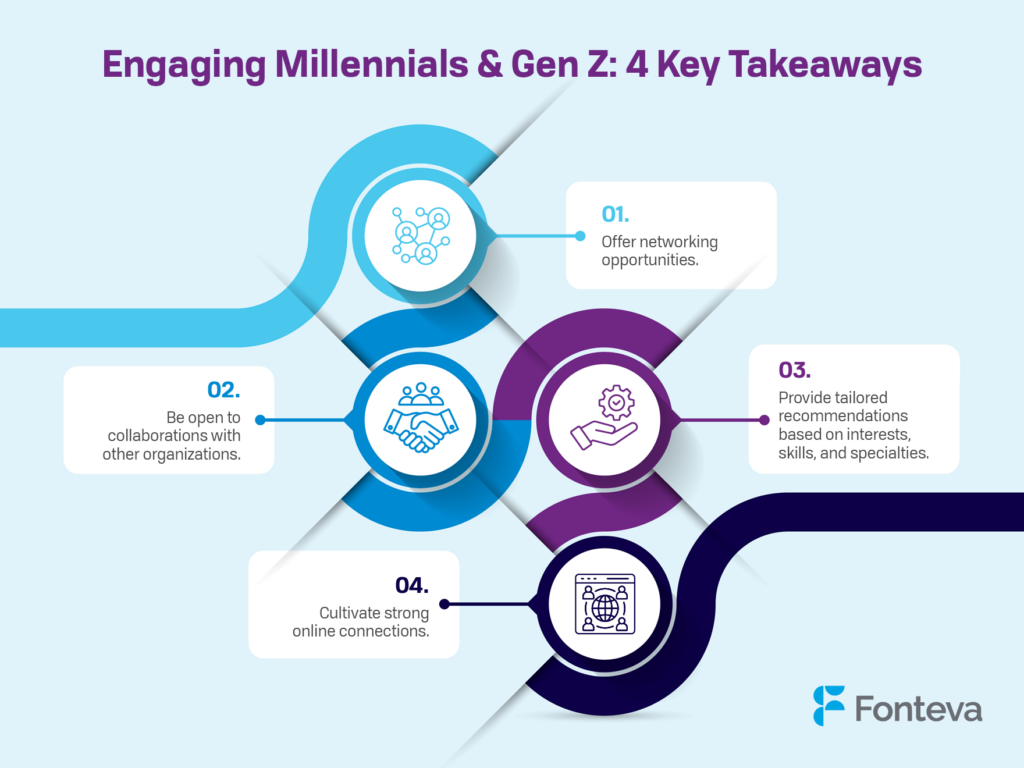
- Offer networking opportunities: Because they are typically in the early stages of their careers, younger professionals want and need opportunities to connect with others in their field.
- Be open to collaboration: Career paths for younger generations are much less likely to run on a straight-line trajectory. Adapt to this by finding ways to collaborate with other associations, shine a light on possibilities, and support unique outcomes.
- Provide tailored recommendations: Specifically and individually invite Millennial and Gen Z members to participate and contribute based on their expressed interests, skills, and specialty areas.
- Form online connections: Find and connect with your younger members and potential members on social media and through technology. Communicate with photos, videos, and easy-to-understand infographics.
If you expand on the core ideas behind each of these tips, you’ll be able to effectively engage other demographics as well, ultimately boosting retention across your membership. Offer plenty of opportunities to connect and demonstrate your attention to detail with personal touches and recommendations. Enhance communications by reaching out through the platforms members already use.

3. Host engaging events.
Many members are craving opportunities to connect and network face-to-face—in fact, this might be the primary reason they joined your association in the first place. To ensure you’re meeting this need and giving members opportunities to form new relationships in their industry, organize a variety of engaging events. You might intersperse your one or two large, annual conferences with smaller, more laid-back gatherings like dinners or workshops.
Additionally, offer events in a variety of formats to ensure all members have a chance to attend. For instance, a virtual happy hour can connect members from across the country without requiring them to travel. Or, you might host a hybrid event where members can choose to attend in-person or virtually.
4. Simplify the renewal process & share reminders.
Finally, aim to make your renewal process as simple and streamlined as possible. If the process is long and complicated, members are less likely to renew and may choose to just let their membership lapse. Consider using association management software that allows members to opt in to automated renewals—this way, they won’t have to manually renew their membership each time.
When sharing renewal reminders, make the prospect of renewing appealing. Gather success stories, testimonials, and metrics that highlight the value your association brings to members. For example, share how your association helped 25 members find jobs through its virtual job board. Or, feature a story of how a specific member secured a promotion when they earned an impressive certification through your continuing education courses.
Wrapping Up
Boosting member recruitment and renewals takes focus and hard work. By assessing, listening, and performing research with your members, you’ll uncover a myriad of ways to appeal to them when and where it matters most. You’ll also learn the best ways to make members feel appreciated and connected, enhance their sense of belonging, and build loyalty.
To learn more about how technology can support these critical initiatives and strategies, explore the following resources:
- Top 20+ Association Management Software (AMS) Picks for 2025. Learn the basics of association management software and browse our top recommended providers.
- 15+ Association Member Engagement Ideas for Better Retention. Don’t underestimate the role member engagement plays in your retention efforts. Learn how to transform your members from passive to active participants in this guide.
- Benefits of A Membership Directory + How to Set It Up. Want to encourage members to connect with one another? Set up a membership directory! Discover why and how in this guide.